
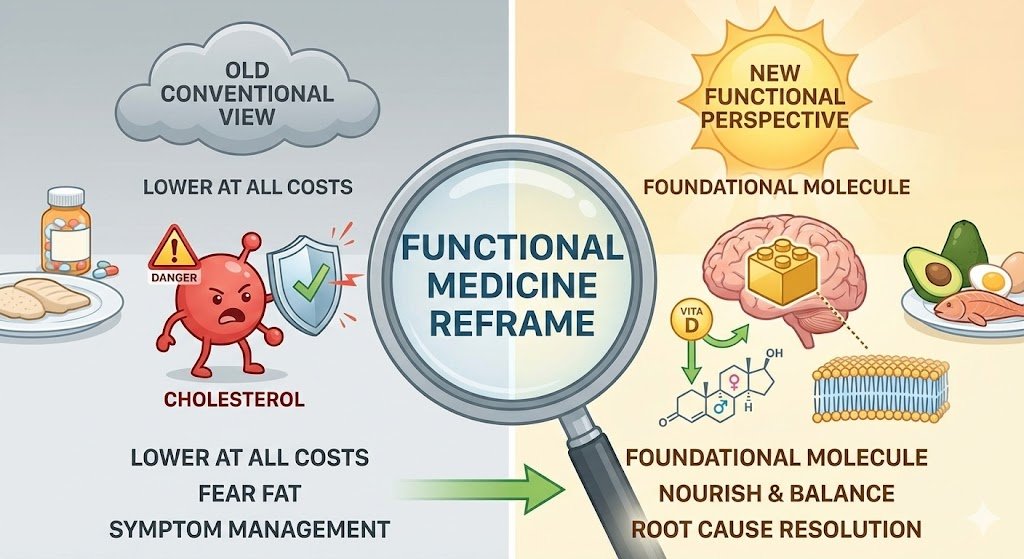
For decades, cholesterol has been blamed as a primary driver of heart disease, cognitive decline, and metabolic dysfunction. Many people were told to fear egg yolks, butter, and saturated fats—yet chronic disease rates have only climbed.
From a functional medicine perspective, it’s time to revisit the cholesterol conversation and separate physiology from propaganda.
Why Is Cholesterol High in the First Place?
From a functional medicine perspective, elevated cholesterol is often a signal, not the root cause of the problem itself. Cholesterol can rise in response to chronic inflammation, insulin resistance, oxidative stress, poor bile flow, liver congestion, nutrient deficiencies, thyroid dysfunction, or even infection. The body may increase cholesterol production as a protective mechanism—to repair cell membranes, buffer inflammation, or support hormone and immune function. Simply lowering cholesterol without addressing these underlying drivers ignores the why and can disrupt the body’s natural compensatory response.
1. The Symptom / Problem
Many people today struggle with:
- Fat malabsorption, gallbladder issues, and nutrient deficiencies
- Chronic inflammation and immune dysfunction
- Brain fog, memory decline, and neurodegenerative conditions
- Hormone imbalances (low testosterone, estrogen, progesterone, cortisol dysfunction)
Ironically, these issues often appear after years of low-fat or cholesterol-restricted diets or aggressive cholesterol-lowering therapies.
2. Why Conventional Answers Fall Short
Conventional medicine has largely focused on lowering cholesterol numbers, rather than asking why cholesterol is elevated—or what happens when it’s too low.
The cholesterol hypothesis, popularized after Dr. Ancel Keys’ work gained national attention in the 1960s, led to:
- Saturated fats being replaced with refined carbohydrates and industrial seed oils
- Real, nutrient-dense foods being replaced with ultra-processed “low-fat” alternatives
- A rise in obesity, diabetes, cardiovascular disease, and neurodegenerative disorders
Conventional medicine focuses heavily on lowering cholesterol numbers, most often by prescribing statin drugs, without addressing:
- Why cholesterol is elevated in the first place
- Whether inflammation, insulin resistance, oxidative stress, or infection is driving risk
- The physiological consequences of suppressing cholesterol production
Statins work by blocking HMG-CoA reductase, a key enzyme in cholesterol synthesis. What’s rarely explained to patients is that this same pathway is responsible for producing:
- Coenzyme Q10 (CoQ10) – critical for mitochondrial energy, heart muscle function, and directly impairs ATP (energy) production
- Dolichols – essential for cellular signaling
- Prenylated proteins – involved in immune and neurological function
Lowering cholesterol does not address root causes of cardiovascular disease—it masks a lab marker while potentially creating new dysfunction.
3. Root Cause Explanation: Cholesterol Is Not the Enemy
Cholesterol is a foundational biological molecule, not a toxin.
Key facts often overlooked:
- ~85% of cholesterol is produced by the body, primarily by the liver
- Only ~15% comes from diet
- When dietary cholesterol is reduced, the body compensates by making more
Cholesterol is essential for:
- Cell membrane integrity and communication
- Brain health (the brain holds ~25% of total body cholesterol)
- Steroid hormone production, including cortisol, aldosterone, estrogen, progesterone, testosterone, and pregnenolone
- Bile production, required to digest fats and absorb vitamins A, D, E, and K
- Vitamin D synthesis in the skin
Suppressing cholesterol production with statins interferes with multiple critical biological systems simultaneously.
4. The Hidden Danger of Low Cholesterol
While high cholesterol is often feared, low cholesterol is rarely discussed—yet dangerous.
Low cholesterol has been associated with:
- Neurodegenerative diseases (Alzheimer’s, Parkinson’s)
- Depression, anxiety, and mood disorders
- Hormonal insufficiency
- Poor immune resilience
- Increased infection severity
LDL cholesterol—often labeled “bad”—actually plays a protective immune role, binding and neutralizing bacterial endotoxins, including those produced by Staphylococcus aureus (MRSA). Individuals with very low cholesterol may be less protected against bacterial toxins.
5. Call to Action: A Functional Medicine Reframe
Functional medicine does not ask:
“How low can we drive cholesterol?”
Instead, it asks:
“Why is cholesterol elevated, and what is the body responding to?”
Before defaulting to statins, consider:
- Assessing inflammation markers (hs-CRP, fibrinogen)
- Evaluating insulin resistance and metabolic health
- Addressing nutrient deficiencies (magnesium, omega-3s, CoQ10)
- Supporting liver, bile flow, and gut health
- Prioritizing real, cholesterol-containing foods like egg yolks, butter, grass-fed meats, fish, shellfish, and cod liver oil
If statins are medically necessary, they should never be prescribed without:
- CoQ10 support
- Ongoing cognitive and metabolic monitoring
- A clear discussion of risks vs benefits
In functional medicine, we focus on lowering inflammation, improving metabolic health, and correcting nutrient deficiencies that drive cholesterol imbalance in the first place. Targeted strategies may include anti-inflammatory nutrition, omega-3 fatty acids, magnesium, fiber, bile support, antioxidants, liver support, and lifestyle interventions that improve insulin sensitivity and mitochondrial function.
If you have been told you have high cholesterol—or are concerned about statin use—there are natural, evidence-based options that can support healthier lipid levels while protecting brain, hormone, and cardiovascular health.
👉 If you’re ready to take a personalized, functional approach, reach out to work with me directly so we can assess your labs, inflammation markers, and overall metabolic picture and create a plan tailored to you.
Take your first step with me here
References
1. Kovacic S, Habicht SD, Eckert GP. Effects of coenzyme Q10 supplementation on myopathy in statin-treated patients: a systematic review and meta-analysis. J Nutr Sci. 2025 Oct 10;14:e72. doi: 10.1017/jns.2025.10043. PMID: 41158831
2. Thakker D, Nair S, Pagada A, Jamdade V, Malik A. Statin use and the risk of developing diabetes: a network meta-analysis. Pharmacoepidemiol Drug Saf. 2016 Oct;25(10):1131-1149. doi: 10.1002/pds.4020. Epub 2016 Jun 9. PMID: 27277934.
3. Ruscica M, Ferri N, Banach M, Sirtori CR, Corsini A. Side effects of statins: from pathophysiology and epidemiology to diagnostic and therapeutic implications. Cardiovasc Res. 2023 Jan 18;118(17):3288-3304. doi: 10.1093/cvr/cvac020. PMID: 35238338.
4. Bansal AB, Cassagnol M. HMG-CoA Reductase Inhibitors. [Updated 2023 Jul 3]. In: StatPearls [Internet]. Treasure Island (FL): StatPearls Publishing; 2025 Jan-. Available from: https://www.ncbi.nlm.nih.gov/books/NBK542212/
5. Tan B, Rosenfeldt F, Ou R, Stough C. Evidence and mechanisms for statin-induced cognitive decline. Expert Rev Clin Pharmacol. 2019 Apr 27;12(5):397-406. doi: 10.1080/17512433.2019.1606711. PMID: 31030614.
